This is an old revision of the document!
Member Portal V2
This is a project driven by @samp20 to build a new member portal to provide Single-Sign-On (SSO) to other Hackspace services.
Architecture
The system is based on a Python Flask application with PostgreSQL as the backend database.
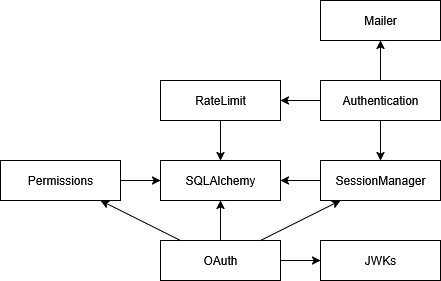
Below is a diagram showing the system dependencies:
Tasks
| Description | Depends on | Assigned to |
|---|---|---|
| Copy across skeleton from storage project | samp20 | |
| Implement Session management | samp20 | |
| Initial OAuth implementation | Session management | - |
| JSON Web Keys implementation | - |
Project layout
portal/: The whole application.forms/: WTForms.static/: Static files, e.g. css.systems/: Core systems, e.g. Session, OAuth, JWK.templates/: Jinja templates.views/: Flask Blueprints with routes. Glue between templates and systems.__init__.py: Application entrypoint.extensions.py: Instantiate extensions and systems.models.py: SQLAlchemy models.
tests/: Tests. Mainly for systems.
Systems
Systems will follow a similar style to Flask extensions. Flask requires that extensions don't store state directly on the class itself, but instead obtain it from the current_app. This allows multiple applications to be instantiated, for example when unit testing.
class _State:
    def __init__(self, app: Flask):
        self.greeting: str = app.config["MYSYSTEM_GREETING"]

class MySystem:
    def __init__(self, other: OtherSystem, app: Flask|None):
        self.other = other

        if app is not None:
            self.init_app(app)

    def init_app(self, app: Flask):
        state = _State(app)
        app.extensions["hs.portal.my_system"] = state

    @property
    def _state(self) -> _State:
        state = current_app.extensions["hs.portal.my_system"]
        return state

    def get_greeting(self) -> str:
        return self._state.greeting
Testing
We will use pytest for our testing. We should aim to test each system in isolation.
Some code will require an active request to test. We can create test endpoints to satisfy these instead of using the fully templated ones.
For now we can probably use an in-memory SQLite database for testing. We may need to switch to a proper PostgreSQL database if we start to depend on DB specific features, at which point we'll need to clean the database before every test run.